


The keto diet is a low-carbohydrate, high-fat diet.It is credited with magical properties: they say that it will not only help you lose weight forever, but will also rebuild your metabolism and get rid of health problems.What really?
The popularity of the keto diet is off the charts: this request displays almost half a million links with tips, meal plans and a list of allowed foods.
Many famous actresses and actors are on the keto diet.But is it worth getting on it for a person who does not plan to surprise Hollywood and rob tombs?For example, someone like me?
What is the keto diet?
There are several types of low-carb nutrition - from the liberal LCHF (low-carbohydrate high-fat) to the extreme carnivore - "carnivore diet", in which the diet contains only animal products.
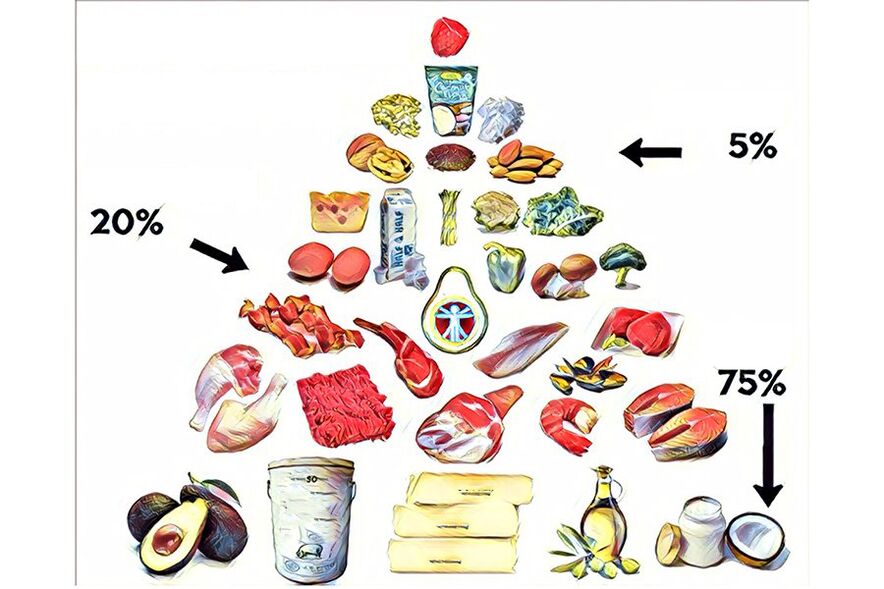
The keto diet falls roughly in the middle between these extremes.This is a low-carb, very high-fat diet.According to various estimates, fats should occupy up to 70-80% of the diet.For this, we are promised an increase in life expectancy by 10 years, increased energy and productivity, and healing from cancer.
How does keto work?
We typically get energy from glycogen, which is obtained from carbohydrates and stored in the muscles and liver.When you switch to a high-fat diet, your metabolism changes.Instead of glucose, the body begins to consume ketones as an energy source, molecules that the liver produces in the absence of glycogen.That is, in fact, in the absence of carbohydrates, our body will receive energy from an alternative source - fats and proteins.

To switch to this alternative source of nutrition, you need to rid the body of glycogen residues and force it into a state of ketosis.This is exactly what a diet high in fat, moderate in protein and minimal in carbohydrates should help with.Different sources determine the dose of carbohydrates to be 20-30 g per day.This corresponds to approximately one and a half slices of bread or 50 g of buckwheat.The rest of the diet is fatty meat, fish, butter, nuts and eggs.
In the 20s of the 20th century, the keto diet was used for children with epilepsy.However, almost a hundred years have passed since then, and today, according to the report, the keto diet is one of the most underused ways to combat this disease.
A new round of popularity for keto came from studying the nutrition of peoples living in extreme cold.“Their diet consists almost entirely of meat and fat. Interest in this diet grew when it became clear that these people have extremely low rates of cardiovascular disease, degenerative brain diseases (dementia, Alzheimer’s, Parkinson’s) and type 2 diabetes.”
But to what extent this depends on nutrition, and where is the cause and where is the effect, it is impossible to say for sure.There are no scientific studies to confirm this connection.
How to enter the ketogenic diet?
Switching to keto is not exactly a pleasant procedure.In the process of giving up carbohydrates, many experience a phenomenon called “keto flu”.“This condition is similar to a cold; aches and drowsiness appear, the throat may hurt, and problems with stool may appear.Most often, symptoms go away within 1-3 days.”
...Or last much longer.“It happens that adaptation lasts from 1 to 6 months - depending on what kind of nutritional system a person followed before, and to what extent he is overweight.Often, unpleasant symptoms are associated not so much with the transition to a different type of diet itself, but with one of its consequences - the death of candida in the body: “As it breaks down, it releases toxic substances, and this makes the person feel unwell.”
Regarding vitamins: “When switching to a keto diet, a person initially loses a lot of water, which is retained, among other things, by glycogen in the muscles.Water takes with it minerals - electrolytes: magnesium, potassium, zinc and sodium.Therefore, their deficiency should be replenished.”
Contraindications for the keto diet
“It is absolutely not suitable for thyroid diseases and for those who love carbohydrates.“And also for those who expect quick results, because this is not always possible.”
“Also, you should not try it yourself for those who have acute problems with the kidneys and liver, pancreatitis, liver dysfunction, porphyria, type 1 diabetes.”
Keto diet menu
It will also be difficult for those who, in principle, love to eat. The list of allowed foods is small, the variety of proteins is generally very limited by their quantity, and the daily protein intake should not exceed 20%.But not everyone wants to eat exclusively fat.
Harmful?Healthy?Or is it still harmful?
There are conflicting opinions on this matter.Supporters of evidence-based medicine most often speak out against it.According to a well-known nutritionist, the keto diet can be deadly for some: “People with diabetes may develop ketoacidosis when switching to this type of diet instead of ketosis.This is a condition that develops when there is a deficiency of insulin. In this case, you can die within 24 hours.The person loses consciousness, then resuscitation.And only if someone finds the victim in time and realizes that he needs help.The fact is that with ketoacidosis, a person emits the smell of acetone, similar to what appears after alcohol abuse.It’s easy for outsiders to confuse one with the other, so the attitude towards a person lying unconscious on the street may be appropriate.”
But, we emphasize, this is only true for people with diabetes.An ordinary healthy person cannot develop ketoacidosis.
“Yes, ketoacidosis can affect people with certain medical conditions - for example, type 1 diabetics, whose body cannot cope with large amounts of ketones.However, insulin-dependent people are people with a serious and sometimes congenital condition.They shouldn't eat high-carbohydrate foods either.On this basis alone, one cannot conclude that the keto diet is dangerous for everyone else.”
In general, there is no scientific evidence that the ketogenic diet is harmful to a healthy person.(Unless, of course, you count digestive problems: for some, this diet causes constipation, and for others, diarrhea.)
But there is no evidence that it is useful.
Perhaps because, as a way of life, she is still very young. “The ketogenic diet has spread recently. And it’s hard to find people who stick with it for long.”
“The longest-term studies I've seen on keto lasted 24 weeks.— As for the statements of people who say that they have been sitting on it for 50 years... People say whatever they want!Every day I see those who claim that they don’t eat anything at all - and for some reason they don’t lose weight.”
In addition, there is a difference between a therapeutic keto diet, that is, one that is prescribed for medical reasons, and a regular nutritional one.The second is milder, does not require extremes and is often combined with a regular low-carb diet: “Many people switch to keto for periods: after 2-3 months, they go back to a more liberal version of low-carbohydrate, high-fat (LCHF) nutrition.”The amount of carbohydrates allowed for LCHF is greater - from 50-70 to 100-120 g per day.But also, of course, not at the expense of sweet rolls, but at the expense of high-quality whole foods - vegetables, fruits, berries, and sometimes some cereals.
Who needs a keto diet anyway?
Research shows that ketosis, without which there is no keto diet, is effective under extreme stress: it prevents oxygen poisoning among deep sea divers and makes ultramarathon runners more resilient.
However, there is again no consensus on this matter.One study found that the keto diet may slightly improve endurance performance (specifically in mountain bikers).And according to another study, it does not improve, but, on the contrary, reduces performance.
Does the keto diet protect against disease?There are also mixed opinions on this matter.There seems to be evidence that it can help treat cancer.However, according to information, the keto diet not only helps with this, but can also cause unwanted side effects.
However, ordinary people are not athletes!— they still switch to the keto diet.
For what? “Including for the sake of clarity of mind, good health and mood, and restful sleep.”Although, as a health benefit, sometimes it is enough to simply follow a low-carbohydrate, high-fat diet - eat 50-70 g of carbohydrates per day: “Some even with such a diet lose weight and solve certain health problems.”
The doctor believes that this is not worth doing: “As a lifestyle, the keto diet is a dubious decision.The keto diet is used only for medical reasons - that is, for epilepsy, and only under the supervision of a doctor.As a permanent diet, it is not physiological, because constant carbohydrate starvation is unnatural.I understand that keto dieters don't think of not eating carbs as hunger, but for the brain, that's exactly what it is.After all, the brain feeds primarily on carbohydrates.And they should be in the diet."
Will the ketogenic diet help you lose weight?
The keto diet does not promise exact numbers: “in X days you will lose Y kg,” but its adherents assure that as soon as you switch to it, the excess weight will begin to disappear.
If only because people on keto obviously eat less.Many do it only twice a day: morning and evening.During the day they do not have lunch because they do not feel hungry.Fats saturate and break down longer.
Scam or truth?
According to a recent study, all diets in the world work exactly the same: they simply create a calorie deficit.That is, for weight loss it is not so important what exactly you stop eating: carbohydrates, fats, proteins, or simply reduce the amount of food.“But a person is designed in such a way that it is easier for him to believe in a miracle diet, rushing to extremes, than to come to an agreement with himself once and for all and constantly eat rationally.– That is why all kinds of diets were, are and will be popular.And each new one will promise lightning-fast weight loss once and for all.”